
You hired a commercial cleaning service in Cumming. The invoices came in on time, the crew showed up on schedule, and the billing matched the contract exactly. But the property manager had fielded two tenant complaints by Tuesday morning, both about the same restroom on the third floor.
Nobody had missed the paperwork. The work just hadn't been done.
This happens more than most cleaning vendors like to acknowledge, not because crews are dishonest, but because most commercial cleaning agreements are written in terms broad enough to accommodate almost any interpretation. "Clean and sanitary" means something different to a facility manager overseeing a medical office park than it does to a crew supervisor working through twelve stops in a single shift.
Before you sign anything, you need to understand what you're actually buying, and what's likely to go unnoticed if you don't put it in writing.
What a Commercial Cleaning Service Actually Covers
The term "commercial cleaning service" applies to a wide range of work. The scope varies considerably by vendor, and most buyers don't realize how much until there's already a problem.
Most commercial cleaning contracts cover recurring maintenance: trash removal, restroom sanitation, vacuuming, mopping, and wiping down high-touch surfaces. These are the routine commercial cleaning servicesthat keep a facility functional between more intensive cleaning cycles.
What typically falls outside that baseline: carpet extraction, window washing, post-construction cleanup, pressure washing, and periodic deep cleans. Some vendors include quarterly deep cleaning, while others price it separately. Neither approach is wrong, but you should know which you're working with before you sign.
The most common misalignment is definitional. What "done" means to the buyer and what "done" means to the crew are often two different things, and the gap only becomes visible after something's been missed. A written scope-of-work document that names specific tasks and specifies how often each gets done is the single most useful thing you can get from a vendor before the first visit.
How Cleaning Needs Differ by Facility Type
Cleaning frequency and protocol requirements aren't uniform across facility types. The right answer depends primarily on how your building is used and the volume of people moving through it daily, with regulatory requirements adding a separate layer for certain industries.
Office buildings and corporate suites
These typically need service three to five days per week. High-touch surfaces (door handles, elevator buttons, and shared equipment) should be addressed daily even when full cleaning runs on a reduced schedule. Most office environments also benefit from quarterly deep cleans to reach areas that routine maintenance doesn't cover.
Medical-adjacent offices
Urgent care, therapy practices, and specialist clinics require stricter protocols. Staff should be using products that meet the EPA Safer Choice program standards on patient-contact surfaces, and the cleaning protocol should be documented well enough to hold up to a compliance review. Medical-grade cleaning standards for healthcare facilities represent a different service tier than standard commercial janitorial work, and not all vendors are equipped to deliver them.
Retail and showroom spaces
These are customer-facing by definition, so visible cleanliness carries more weight than it does in back-of-house environments. Stock rooms and service areas can tolerate a lighter schedule, but any space a customer sees should be addressed on every visit.
Restaurants and food service environments
These operate under health codes that govern how surfaces are sanitized and how grease is managed, requirements that show up on inspection reports, not just preference lists. A vendor who hasn't navigated commercial kitchen compliance before is a meaningful operational risk.
Government and municipal buildings
These often require bonded staff and background checks as a contract condition. Confirm those requirements before you start evaluating vendors, not after.
Quick Reference: Facility Type Cleaning Standards
The Standards a Good Commercial Cleaning Service Should
Hold Itself To
Knowing what "good" looks like makes it easier to evaluate who can actually deliver it, and to recognize when they're falling short.
The ISSA cleaning industry standards provide one of the most referenced benchmarks in the field. Published by the Worldwide Cleaning Industry Association, they document standard times and frequencies for common cleaning tasks. They're worth reviewing before you evaluate vendor proposals, because they give you a reference point when a quoted scope seems thin.
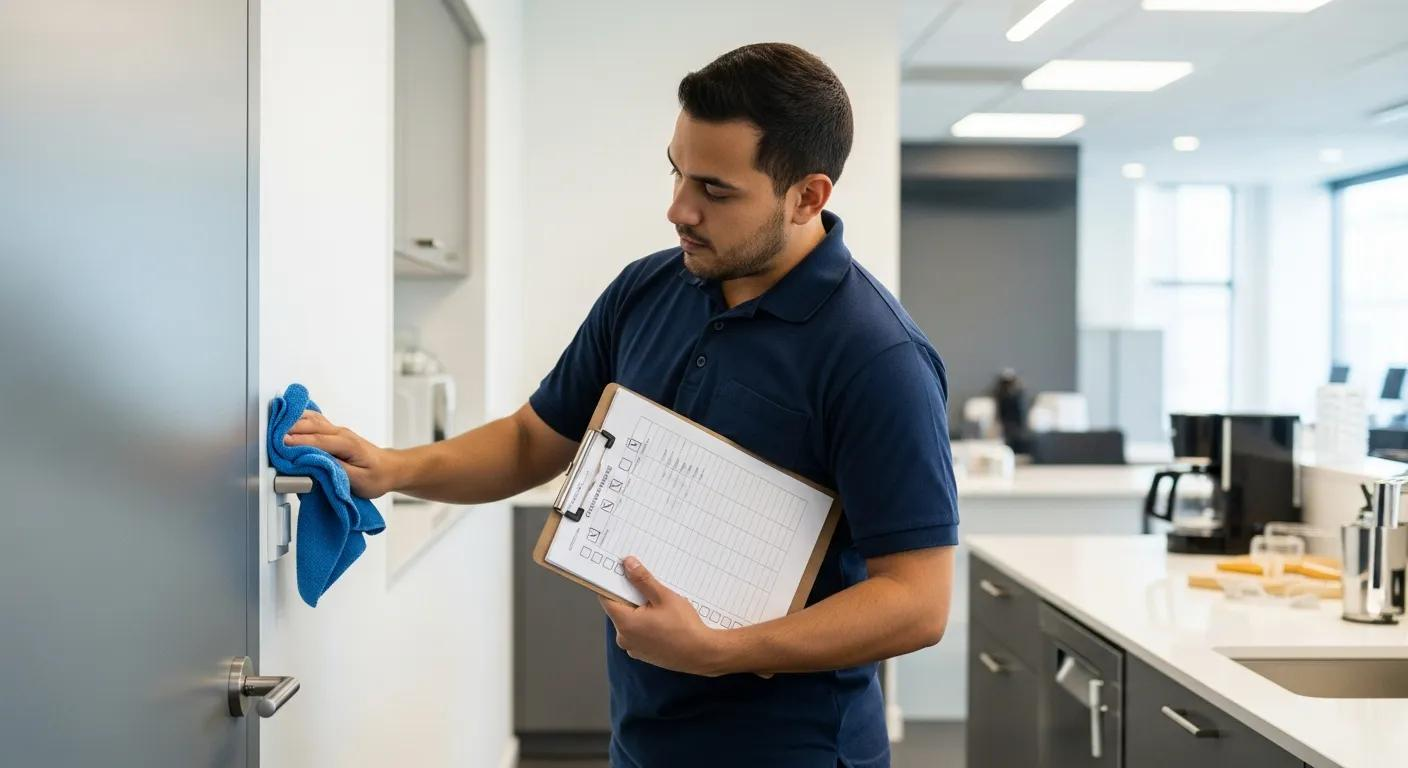
A properly completed cleaning visit looks exactly like what's written in the scope-of-work document. When it doesn't, the first question worth asking is whether the crew was working from a checklist or from memory. A vendor who invests in modern cleaning equipment and follows documented protocols is running a measurably different operation than one relying on the same routine they used ten years ago.
The difference between a cleaning that looks clean and one that measurably reduces pathogen load usually comes down to what happens on high-touch surfaces. Door handles and light switches accumulate bacteria at rates that visual inspection alone doesn't catch, and they're also among the easiest surfaces to skip when a crew is moving quickly through a large site.
OSHA workplace sanitation standards establish regulatory minimums for hygiene in commercial environments, particularly in food service and healthcare-adjacent settings. A vendor who understands those requirements and can speak to them clearly is worth paying attention to.
Start your post-clean walkthroughs with restrooms and the kitchen. Those surfaces are the most reliable indicators of how thoroughly a crew is working. If they're consistently clean, the rest of the facility usually follows.
What to Look for When Evaluating Vendors
Most commercial cleaning failures are predictable. They show up during the evaluation process if you're asking the right questions.
Staff assignment model
Ask whether you'll have a dedicated crew or a rotating one. Familiarity matters. A dedicated team learns your building over time, which areas need more attention, what your standards actually look like in practice, in a way a rotating crew simply can't replicate.
Cleaning documentation
Ask to see a sample checklist for a facility similar to yours. A vendor running a checklist-based operation is measurably different from one that relies on crew judgment. The checklist also gives you a standard to reference when something gets missed.
Insurance and bonding
Get certificates of insurance before the conversation moves to price. General liability and workers' compensation are the baseline. Bonding protects you in the event of a theft claim. A vendor who can't produce documentation on request, before any commitment is made, is telling you something about how they run the business.
References
Ask specifically for references from facilities that resemble yours in type and cleaning frequency. A testimonial from a warehouse doesn't tell you much about performance in a professional office environment. Check Live Oak on Google to see how clients across offices, medical suites, and restaurants describe the service.
Account management
When something goes wrong, who do you call? One named contact who knows your account is worth more than a general support line. Ask how they handle service complaints before a real one tests the answer.
For office cleaning services for professional workspaces, staff consistency and documentation quality tend to be the most reliable predictors of long-term performance.
How to Structure a Service Agreement That Works for Both Sides
A well-written service agreement protects you. It also tells you a lot about the vendor before the first visit happens.
The scope-of-work section needs to be specific enough that there's no room for interpretation. If it doesn't name the task and the frequency together, it isn't a scope. It's a general description. "Vacuum all carpeted areas, wipe all horizontal surfaces, empty all trash receptacles, and sanitize all restroom fixtures, Monday through Friday" is a scope. "Clean common areas" is not.
The quality standard and re-clean policy should be written out clearly. What triggers a redo? Who initiates it? What's the response window? A vendor who won't commit this to paper is communicating something before work even starts.
Access and security protocols belong in the agreement before day one. Key management, alarm codes, and after-hours procedures should be documented, not handled informally over the phone.
Termination and notice terms matter when the relationship isn't working. Thirty days' notice on both sides is a reasonable standard. Anything requiring ninety days or more is worth a direct question.
Insurance certificates should be attached to the agreement as an exhibit, with a copy provided before the first visit.
Making the Relationship Work After Day One
Many cleaning service problems are relationship problems before they're performance problems. They develop when expectations aren't clearly defined at the start, and deepen when feedback is delayed or too vague to act on.
Build a 30-day check-in into the contract as a standard term. Use it to cover what's actually happening in the field, not just whether invoices are matching. If adjustments need to be made to the scope or schedule, the 30-day mark is the right time to make them, before the gap becomes a pattern.
When something doesn't meet the standard, specificity produces better outcomes than frustration. "The third-floor restroom wasn't serviced properly on Tuesday: fixtures weren't wiped, and there was debris near the second stall." creates a correction. "The restrooms weren't clean" creates a conversation that doesn't go anywhere useful.
Keep a short log of recurring issues. Two or three documented instances of the same problem give you standing to request a change in protocol, or, if needed, a conversation about the contract terms. Problems that aren't documented tend to get minimized over time.
Switching vendors isn't always the answer. When cleaning service problems get traced back carefully, they often turn out to be scope problems. The agreement didn't specify enough, or expectations drifted without being corrected in writing. Resolve that before you re-bid, or the same friction follows you to the next vendor.
Frequently Asked Questions
-
Standard service typically covers trash removal, restroom sanitation, vacuuming, mopping, and high-touch surface wiping. Specialty tasks like carpet extraction or window washing are usually priced separately and should be written into the agreement if needed.
-
Most professional offices need cleaning at least three times per week, and often more depending on foot traffic and building usage. Medical or food service facilities typically require daily service. Regulatory requirements for certain industries should factor into that decision alongside cost.
-
Janitorial typically refers to routine daily or nightly maintenance tasks. Commercial cleaning is a broader category that includes periodic deep cleaning, floor care programs, and specialty services on a defined schedule.
-
Reputable providers carry general liability insurance and bonding at minimum. Always request certificates of insurance before the first visit, not after the contract is signed.
-
A five-minute post-clean walkthrough focused on restrooms and high-touch surfaces will catch most issues. Compare what you find against the scope-of-work checklist in your service agreement.
-
Document the specific issue, contact your account manager promptly, and reference the re-clean policy in your agreement. A vendor without a written re-clean policy is worth asking about before the first complaint occurs, not after.
What It Comes Down To
Most of what makes a commercial cleaning relationship work comes down to what you establish before the first visit. Define the scope in writing, and when you ask for references, ask specifically for facilities like yours, not just whoever's willing to return a call.
The commercial cleaning service market has no shortage of options. The difference between a vendor who performs consistently and one who doesn't usually shows up before the contract is ever signed, in how specifically they answer your questions and what they're willing to put in writing. Those two things tell you more than any marketing material will.
If you're a facility manager or property manager in Cumming, GA, or within 30 miles of North Metro Atlanta, Live Oak Commercial Cleaning is a name you can trust for all your commercial cleaning needs. Owner Micah Purvis built the business around consistent crew assignments, flexible scheduling, modern cleaning equipment, and a named account contact for every client.